Table of Contents
ToggleWhen the Wild Update dropped in June 2022 (Java Edition 1.19, Bedrock Edition 1.19.0), Minecraft introduced a new wetland biome and a completely unique tree-growing mechanic. The mangrove propagule isn’t just another sapling, it’s a multi-stage, water-friendly growth item that behaves differently from every other tree type in the game. Whether you’re hunting for that warm reddish wood tone for your build, setting up an efficient farm, or just curious about how these dangling seedlings work, understanding propagules unlocks a whole new branch of gameplay.
This guide breaks down everything: where to find them, how they grow, what makes them different, and how to put them to work in your world. No filler, just the specifics you need to master mangrove propagules and the trees they spawn.
Key Takeaways
- Mangrove propagules are the only Minecraft sapling that can grow in or on water and mud blocks, making them ideal for wetland and underwater builds since traditional saplings fail in waterlogged conditions.
- Mangrove propagules grow through five visible stages before maturing and can be planted on dirt, grass, coarse dirt, podzol, mycelium, moss, farmland, mud, or water—offering far greater planting flexibility than other saplings.
- You can instantly grow a mangrove propagule into a full tree using bone meal, which is essential for efficient farming, though the trees require at least 5×5 blocks of vertical clearance and light level 9 or higher.
- Mangrove wood has a unique warm, reddish-brown tone that pairs well with stone, deepslate, and light concrete, giving builders a distinctive aesthetic option between oak and acacia tones.
- Mangrove swamps are found in warm biomes near jungles, deserts, and coastlines, and you can locate them efficiently using the /locate biome command or online seed databases to find propagules.
What Is a Mangrove Propagule in Minecraft?
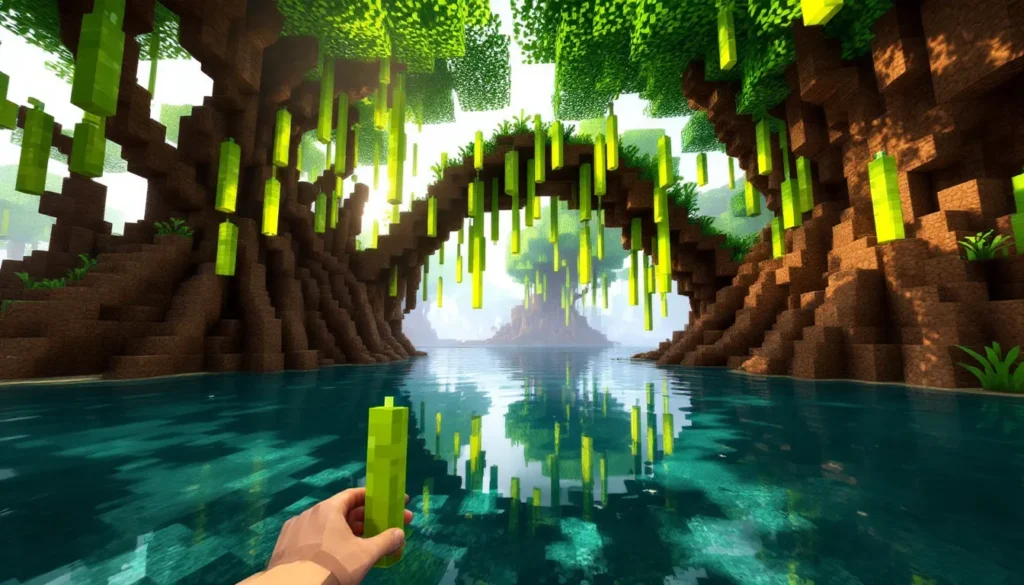
A mangrove propagule is the sapling equivalent for mangrove trees, introduced in the 1.19 Wild Update. It appears as a small, elongated green shoot that hangs from mangrove tree leaves, and unlike traditional saplings, it goes through visible growth stages before it’s ready to plant or drop.
Propagules spawn naturally on mangrove trees in mangrove swamp biomes. They hang from the underside of leaf blocks and will eventually mature and drop on their own, or you can break them manually at any stage. Once collected, they function as plantable items, but with some key mechanical differences.
How Propagules Differ from Traditional Saplings
Most saplings in Minecraft are instant-use items: you place them on dirt or grass, and they begin growing immediately. Mangrove propagules break that mold in a few important ways:
- Growth stages: Propagules hanging from leaves progress through four visible stages before they’re ready to drop. You can harvest them at any stage, but only fully mature propagules are guaranteed to drop.
- Planting flexibility: Propagules can be planted on dirt, grass, coarse dirt, podzol, mycelium, moss blocks, farmland, mud blocks, and even in or on top of water. This makes them the only sapling that thrives in waterlogged conditions.
- Water-friendly mechanics: When planted underwater or on mud, propagules will still grow into full mangrove trees, complete with exposed root systems. Traditional saplings fail or behave unpredictably in water.
- Unique tree structure: Mangrove trees generate with mangrove roots that extend above and below the planting surface, creating natural bridges and tangled aesthetics that no other tree type offers.
This flexibility makes propagules ideal for swamp builds, underwater bases, and creative landscaping where other saplings would simply pop off or fail to grow.
Where to Find Mangrove Propagules
Mangrove propagules are exclusive to mangrove swamp biomes. You won’t find them in chests, village trades, or anywhere else, your only source is the biome itself or a farm you’ve built.
Locating Mangrove Swamp Biomes
Mangrove swamps are a warm variant of the standard swamp biome. They generate in warmer temperature zones and are visually distinct: shallow water, dense mangrove trees with sprawling roots, and a murky, tropical feel. They’re most common near jungles, deserts, and badlands, but can appear in other warm regions.
To locate one efficiently:
- Use the /locate biome minecraft:mangrove_swamp command in Java Edition (cheats enabled) or Bedrock’s equivalent.
- Explore coastlines and river deltas in warm biomes, mangrove swamps often border oceans or large water bodies.
- Check online seed databases or use tools like Chunkbase to preview biome distributions before committing to a long journey.
Mangrove swamps are relatively common in post-1.19 worlds, but older worlds generated before the Wild Update won’t have them in already-loaded chunks. You’ll need to venture into unexplored territory.
Identifying Mangrove Trees and Harvesting Propagules
Mangrove trees are unmistakable. They have thick, twisting mangrove logs that curve and split, surrounded by mangrove roots (a separate decorative block) that form natural stilts above the waterline. The canopy is made of mangrove leaves, which are slightly more vibrant than oak.
To harvest propagules:
- Look for the small green shoots hanging from the underside of leaf blocks. They resemble upside-down cacti or tiny pickles.
- Break them by hand or with any tool, there’s no speed benefit to using shears or an axe.
- Collect as many as you need. A single mangrove tree can yield 5–15 propagules depending on its size and how many have already matured and dropped.
Propagules also drop naturally over time as they reach full maturity, so if you’re patient, you can gather them from the ground beneath trees without breaking leaves.
How to Grow Mangrove Trees from Propagules
Growing mangrove trees is more flexible than other saplings, but there are still specific mechanics to understand if you want reliable results.
Planting Propagules: Soil, Water, and Mud Blocks Explained
Mangrove propagules can be planted on the following block types:
- Dirt, grass block, coarse dirt, podzol, mycelium, rooted dirt, moss block, farmland
- Mud blocks (introduced in 1.19 alongside mangroves)
- Directly in water (as a waterlogged block)
- On top of water (if there’s a solid block beneath)
The most unique mechanic: propagules planted in water or on mud will still grow into full trees. The resulting mangrove tree will generate with roots that extend into and around the water, creating natural-looking wetland structures. This is the only tree type that can grow in waterlogged conditions without breaking.
For best results:
- Plant on mud or in shallow water (1–2 blocks deep) to mimic natural mangrove swamp aesthetics.
- Ensure there’s at least a 5×5 area of open space above the propagule and 3–4 blocks of vertical clearance. Mangrove trees can grow quite tall and wide.
- Light level must be 9 or higher, just like other saplings.
Growth Stages and Time Requirements
Once planted, a mangrove propagule goes through five growth stages before becoming a full tree. Each stage is visually distinct, the propagule grows taller and develops more leaves as it matures.
Growth is randomized, but on average:
- Without bone meal: A propagule takes roughly 20–60 minutes of real-time to grow into a tree, depending on RNG and tick speed.
- Tick speed: Default random tick speed is 3. If you’re playing on a server or have modified tick speed, growth will vary.
Mangrove trees don’t require a 2×2 planting pattern like spruce or jungle giants. Each propagule grows into a single, often sprawling tree with multiple trunks and branches. Some players on game guides note that mangrove trees can generate with irregular shapes, making them less predictable for tight farm designs but excellent for organic builds.
Using Bone Meal to Speed Up Growth
Like all saplings, bone meal instantly grows a mangrove propagule into a full tree, no waiting required. Each application has a chance to advance the propagule one stage, so you may need 2–5 bone meal to force a full tree, depending on the current growth stage.
This is critical for efficient farming. If you’re running a skeleton farm or have a composter setup, you can spam bone meal and harvest mangrove wood in seconds. Just be ready for the tree’s roots to sprawl unpredictably, make sure you’ve got room or a plan to prune.
Unique Uses and Benefits of Mangrove Propagules
Beyond just growing trees for wood, mangrove propagules and the trees they produce have several niche uses that set them apart.
Building Mangrove Wood Farms
Mangrove wood farms are viable and relatively simple, though less space-efficient than oak or birch due to the tree’s irregular growth pattern. The key advantage: you can build a farm directly in or over water, which is useful for ocean or swamp-based builds.
Basic setup:
- Create a flat platform of mud or dirt blocks, either above water or in a shallow pool.
- Space propagules 5–6 blocks apart in a grid.
- Use bone meal for instant growth, then chop down trees and replant.
- Roots and logs will tangle, but with practice you can harvest efficiently.
Some modding communities have explored automation mods that handle mangrove tree harvesting more cleanly, but vanilla Minecraft doesn’t support full automation without complex redstone contraptions.
Decorative and Aesthetic Applications
Mangrove propagules themselves are decorative blocks. Placed in a pot or on a fence post, they add a unique tropical or wetland vibe to builds. The small, dangling aesthetic works well in greenhouses, terrariums, or hanging garden designs.
Mangrove trees, and the mangrove roots they generate, are even more valuable for builders:
- Roots create natural-looking stilts, bridges, and tangled structures.
- The warm, reddish-brown tone of mangrove wood contrasts beautifully with darker woods like dark oak or spruce.
- Mangrove leaves have a subtly different color, useful for layered or gradient canopy effects.
If you’re building a swamp village, tropical outpost, or riverside settlement, mangroves are the go-to tree type.
Composting and Other Utility Uses
Mangrove propagules have a 30% chance to raise a composter’s level by one when added. This is lower than the 50% chance of wheat or carrots, but higher than sticks (no chance) or saplings (also 30%).
If you have excess propagules from a farm, tossing them into a composter is a decent way to generate bone meal, which you can then loop back into growing more trees. It’s not the most efficient composting material, but it’s a renewable option if you’re already farming mangroves.
Mangrove Wood and Its Crafting Recipes
Once you’ve grown and chopped down a mangrove tree, you’re left with mangrove logs, mangrove roots, and mangrove leaves. Each has its own uses.
What You Can Craft with Mangrove Logs and Planks
Mangrove logs can be stripped with an axe to produce stripped mangrove logs, and both can be crafted into mangrove planks (4 planks per log). From there, the crafting tree is the same as other wood types:
- Mangrove stairs, slabs, fences, fence gates, doors, trapdoors, pressure plates, and buttons
- Mangrove signs and hanging signs (added in 1.20)
- Mangrove boats and boats with chests (useful for swamp or ocean transport)
- Crafting tables, chests, barrels, and other utility blocks (though these don’t retain the mangrove texture)
Mangrove roots are a decorative block that can’t be crafted into planks, but they can be used as fuel (smelts 1.5 items per block) or composted. They’re primarily aesthetic, great for custom tree builds or root cellar designs.
Unique Color and Texture for Builders
Mangrove planks have a warm, reddish-brown hue that sits between acacia and jungle in tone. The wood grain is subtle and smooth, making it ideal for flooring, interior walls, and furniture.
Key builder notes:
- Mangrove planks pair well with stone bricks, deepslate, and white or light gray concrete for modern or rustic builds.
- Mangrove doors and trapdoors have a rich color that stands out against lighter woods like birch or stripped oak.
- The mangrove boat is visually distinct and looks great in tropical or swamp-themed builds, especially for decorative docks.
If you’re looking for variety in your palette, mangrove is one of the best additions since dark oak. It’s warm without being orange (like acacia) and has more character than oak or birch.
Tips and Tricks for Mangrove Propagule Farming
Efficient farming is all about setup, spacing, and workflow. Mangrove trees grow unpredictably, but you can mitigate that with smart design.
Creating an Efficient Mangrove Tree Farm
Here’s a step-by-step for a simple, high-yield farm:
- Flatten a large area (at least 20×20 blocks) with mud, dirt, or grass. Mud gives the most authentic swamp aesthetic.
- Dig shallow water channels (1 block deep) between rows if you want a wetland look, or keep it dry for easier harvesting.
- Plant propagules in a 5×5 grid. This spacing prevents trees from overlapping too much while maximizing density.
- Stockpile bone meal. A single skeleton farm or composter can supply enough to grow trees on-demand.
- Harvest and replant. Mangrove trees drop logs, roots, and propagules when chopped. Collect everything and replant immediately.
Pro tip: Use a Fortune III axe on leaves to maximize propagule drops. While axes don’t apply Fortune to leaves in vanilla Minecraft, some players on walkthroughs recommend shears for bulk leaf collection, which can then be composted or used decoratively.
Automating Propagule Collection
Full automation is tricky without mods, but semi-automation is possible:
- Hopper + water flow: Plant mangrove trees above a layer of hoppers with water channels to funnel dropped propagules into chests. This works if you let propagules mature and fall naturally, though it’s slow.
- Observer + piston: Set up observers to detect when a propagule reaches full maturity, then trigger a piston to break it. This requires redstone knowledge and is more effort than it’s worth for most players.
- Manual with efficiency: The most practical approach is to plant in a grid, bone meal everything, chop it all down with an axe enchanted with Efficiency V, and replant. With practice, you can clear and replant a 20×20 farm in under 10 minutes.
If you’re on Java Edition and open to mods, automation mods like Create or Industrial Foregoing can handle tree farming more elegantly, but that’s outside vanilla scope.
Common Mistakes to Avoid When Working with Propagules
Even experienced players stumble with mangrove mechanics. Here are the most common errors and how to avoid them:
Planting in insufficient space. Mangrove trees need at least 5×5 blocks of open air above the propagule. If you plant too close to a ceiling or other trees, growth will fail. Always check vertical clearance.
Expecting 2×2 growth. Unlike jungle or spruce, mangrove propagules don’t support 2×2 planting for giant trees. Each propagule grows individually. Trying to force a 2×2 pattern just wastes space.
Ignoring light levels. Propagules require a light level of 9 or higher, just like other saplings. If your farm is in a cave or dark swamp, add torches or glowstone.
Breaking immature propagules and expecting drops. Propagules at early growth stages (hanging from leaves) have a lower drop rate when broken. If you’re farming them, wait for full maturity or use shears on the leaf block to guarantee the drop.
Forgetting to clear mangrove roots. After chopping a tree, mangrove roots remain as decorative blocks. They don’t despawn and can clutter your farm. Either break them manually or incorporate them into your build.
Overusing bone meal without space. If you spam bone meal in a cramped area, the tree will attempt to grow, fail, and consume the bone meal anyway. Always confirm there’s room before committing resources.
Avoiding these pitfalls will save you time, bone meal, and frustration, especially when scaling up to larger farms.
Mangrove Propagules vs. Other Saplings: A Comparison
How do mangrove propagules stack up against the six other sapling types (oak, birch, spruce, jungle, acacia, dark oak)? Here’s a quick breakdown:
Growth flexibility: Mangrove propagules are the only sapling that can grow in or on water and on mud blocks. Every other sapling requires dry land (dirt, grass, podzol, etc.). This makes mangroves the best choice for aquatic or swamp builds.
Tree size and shape: Mangrove trees are medium-sized, comparable to oak or birch, but with irregular branching and root structures. They’re less predictable than oak but more compact than jungle or spruce.
Wood yield per tree: Mangrove trees drop roughly 10–20 logs on average, plus roots. This is lower than jungle or spruce but on par with oak. The roots add bulk but aren’t useful as planks.
Aesthetic and color: Mangrove wood has a unique reddish-brown tone that no other wood type matches. Oak, birch, and spruce are neutral: jungle and acacia are more yellow/orange. Mangrove fills a middle ground with warmth and character.
Farming efficiency: Oak and birch are still the fastest and most space-efficient for pure log output. Mangrove farms are competitive but require more room due to irregular growth. Dark oak and jungle (2×2) are less efficient overall.
Availability: Mangrove propagules are biome-exclusive and only available post-1.19. Oak, birch, and spruce are far more common and easier to obtain early-game.
Special mechanics: Only mangrove propagules have visible growth stages and water-planting capability. This makes them the most mechanically unique sapling in the game.
Bottom line: if you’re building in or near water, want a warm wood tone, or just enjoy unique mechanics, mangrove propagules are your best bet. For raw efficiency and early-game farming, oak and birch still win.
Conclusion
Mangrove propagules are more than just another tree, they’re a gateway to waterlogged builds, aesthetic variety, and a unique farming challenge. Whether you’re setting up a swamp base, hunting for that perfect warm wood tone, or just exploring the mechanics introduced in the Wild Update, understanding how propagules grow and behave gives you a serious edge.
Plant them in water, on mud, or on dry land. Bone meal them for instant trees or let them mature naturally. Use the wood for builds, the roots for decoration, and the propagules themselves as composting fodder or farmable renewables. Just remember to give them space, light, and a little patience.
Now get out there, find a mangrove swamp, and start growing.