Table of Contents
ToggleBattlefield tools have shaped the outcome of wars for thousands of years. From bronze swords to satellite-guided systems, military equipment has evolved alongside human conflict. Soldiers have always depended on their gear, weapons, communication devices, and survival equipment, to gain advantages over enemies. This article explores the essential battlefield tools that have defined military history, from ancient times to modern warfare. Understanding these tools reveals how technology and strategy have transformed combat across centuries.
Key Takeaways
- Battlefield tools have evolved from ancient bronze swords and spears to modern satellite-guided weapons and drones.
- Communication devices like encrypted radios and GPS technology rank among the most critical battlefield tools for military coordination and navigation.
- Modern body armor and helmets have transformed from simple steel protection into integrated systems that save countless lives.
- Precision-guided munitions and smart bombs have dramatically increased accuracy while reducing collateral damage in warfare.
- Personal survival gear—including first aid kits, water filtration, and multitools—remains essential for keeping soldiers effective in the field.
Ancient and Medieval Battlefield Tools
Ancient battlefield tools laid the foundation for military technology. Early warriors relied on weapons made from stone, bronze, and iron. The spear served as one of the oldest and most effective battlefield tools, used by Greek hoplites, Roman legionaries, and countless other armies.
Swords became symbols of military power. The Roman gladius, a short thrusting sword, gave legions a deadly advantage in close combat. Medieval knights carried longswords and broadswords that required years of training to master. These battlefield tools determined life and death in hand-to-hand fighting.
Armor evolved alongside weapons. Bronze helmets protected ancient soldiers, while medieval knights wore full plate armor weighing up to 60 pounds. Shields ranged from the large Roman scutum to the iconic kite shields of Norman warriors. Each piece of defensive equipment represented careful engineering for its era.
Siege equipment changed how armies attacked fortifications. Battering rams broke through gates. Catapults and trebuchets hurled stones at walls from safe distances. The trebuchet could launch 300-pound projectiles over 300 yards, a devastating battlefield tool that ended many sieges.
Archers carried bows that varied by region and culture. English longbowmen famously devastated French cavalry at Agincourt in 1415. Composite bows used by Mongol horsemen allowed rapid fire while riding. These ranged battlefield tools extended a soldier’s killing power beyond arm’s reach.
Modern Military Equipment and Technology
Modern battlefield tools bear little resemblance to their ancient counterparts. Gunpowder changed everything. Firearms replaced swords and bows as primary weapons by the 17th century. Today’s assault rifles can fire 600 rounds per minute with accuracy at 500 meters.
Explosives have become essential battlefield tools. Hand grenades allow soldiers to clear rooms and trenches. Rocket-propelled grenades (RPGs) give infantry the ability to destroy armored vehicles. Improvised explosive devices (IEDs) have become common threats in recent conflicts.
Armored vehicles transformed ground warfare. Tanks first appeared in World War I and now dominate modern battlefields. The M1 Abrams tank, for example, features 120mm main guns and composite armor that can withstand most anti-tank weapons. These battlefield tools combine firepower with protection.
Air support has become crucial to military operations. Fighter jets, bombers, and attack helicopters deliver firepower from above. Drones now conduct surveillance and strikes without risking pilot lives. The MQ-9 Reaper drone carries Hellfire missiles and can stay airborne for over 27 hours.
Precision-guided munitions have increased accuracy dramatically. Smart bombs use GPS or laser guidance to hit targets within feet of their aim point. This technology reduces collateral damage while increasing the effectiveness of battlefield tools. Modern militaries invest billions in these systems annually.
Communication and Navigation Devices
Communication devices rank among the most critical battlefield tools. Soldiers must coordinate movements, report enemy positions, and call for support. Poor communication has caused more military disasters than enemy action.
Radios revolutionized battlefield communication. World War II saw widespread use of portable radio sets. Today’s soldiers carry encrypted digital radios that resist jamming and interception. The AN/PRC-152 handheld radio provides secure voice and data transmission across multiple frequencies.
GPS technology has transformed military navigation. Soldiers can determine their exact position within meters anywhere on Earth. GPS-enabled battlefield tools help units coordinate movements, mark targets, and avoid friendly fire incidents. The U.S. military operates its own dedicated GPS satellite network.
Night vision devices extend operations into darkness. First developed during World War II, modern night vision goggles amplify available light by thousands of times. Thermal imaging detects heat signatures, allowing soldiers to spot enemies through smoke, fog, and complete darkness. These battlefield tools give equipped forces significant advantages.
Satellite communication links soldiers to command centers worldwide. Real-time video feeds from drones reach decision-makers instantly. Data sharing between units happens in seconds. Modern battlefield tools create networks of information that previous generations couldn’t imagine.
Personal Gear and Survival Tools
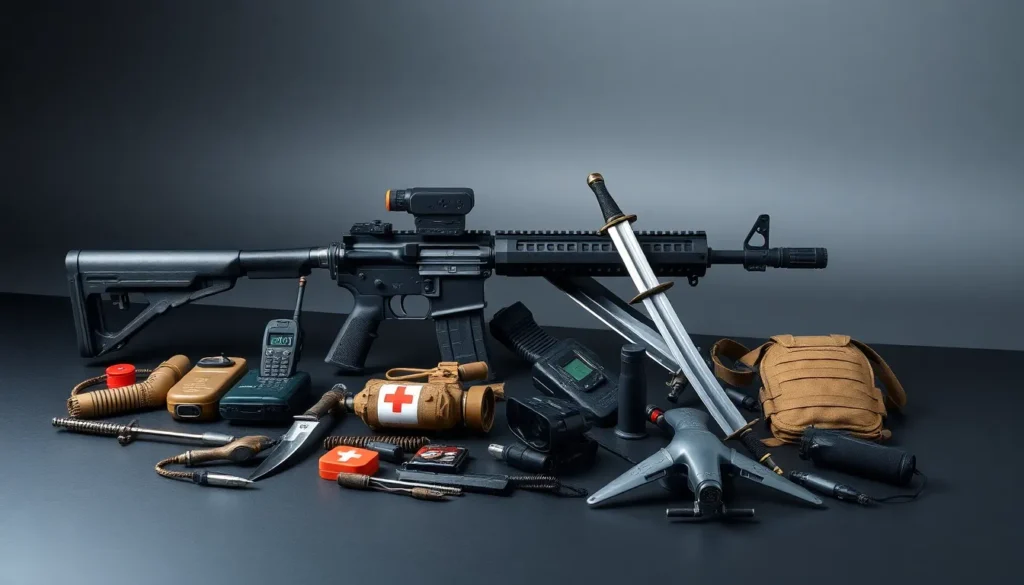
Personal battlefield tools keep individual soldiers alive and effective. Body armor has saved countless lives. Modern ceramic plate carriers can stop rifle rounds that would have killed soldiers in earlier wars. The Interceptor Body Armor system, for instance, weighs about 16 pounds and provides protection against most small arms fire.
Helmets protect the most vulnerable body part. The Advanced Combat Helmet (ACH) shields against shrapnel, debris, and some ballistic threats. Many helmets now mount night vision devices, cameras, and communication equipment. These battlefield tools have evolved from simple steel pots to integrated systems.
First aid equipment gives soldiers immediate medical capability. Every soldier carries an Individual First Aid Kit (IFAK) with tourniquets, bandages, and hemostatic agents. Quick treatment of wounds on the battlefield dramatically improves survival rates. Medical battlefield tools save lives that previous wars would have lost.
Knives and multitools remain essential gear. Combat knives serve as weapons, tools, and survival equipment. Multitools combine pliers, screwdrivers, and blades in compact packages. These simple battlefield tools solve countless practical problems in the field.
Water filtration and purification equipment keeps soldiers hydrated. Clean water prevents disease and maintains physical performance. Modern filters remove bacteria, parasites, and many chemicals from questionable water sources. Such battlefield tools might seem basic, but they prevent casualties from illness.