Table of Contents
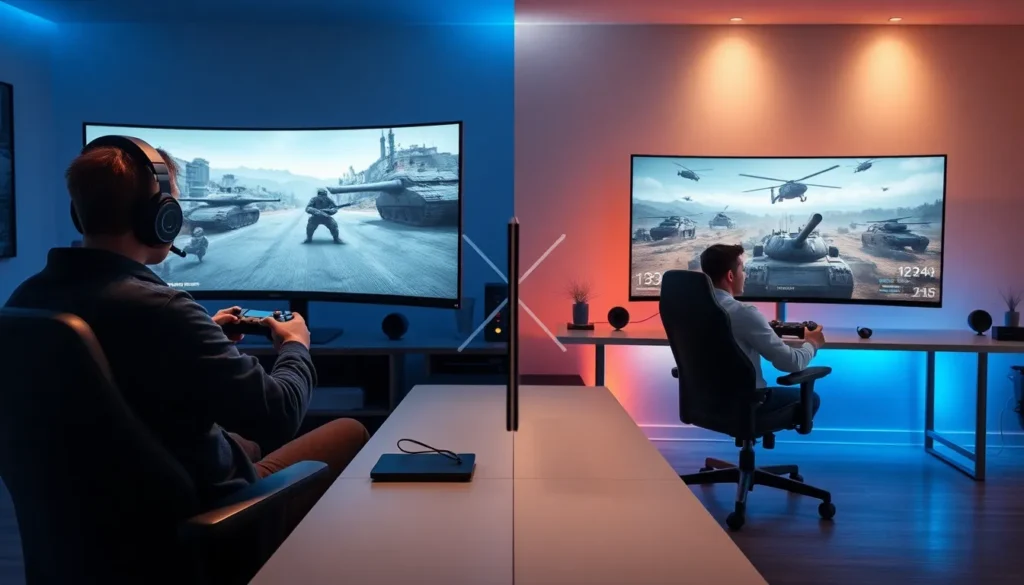
ToggleThe Battlefield vs Call of Duty debate has divided shooter fans for over two decades. Both franchises dominate the first-person shooter genre, yet they offer distinctly different experiences. Battlefield emphasizes large-scale warfare with vehicles and destructible environments. Call of Duty focuses on fast-paced, infantry-driven combat with tight gunplay. Choosing between them depends on what players want from their shooter experience. This guide breaks down the key differences between Battlefield vs Call of Duty to help players pick the right franchise.
Key Takeaways
- Battlefield vs Call of Duty comes down to scale: Battlefield offers large-scale warfare with vehicles, while Call of Duty delivers fast-paced, infantry-focused combat.
- Call of Duty maps are compact for constant action, whereas Battlefield maps span kilometers and support up to 128 players.
- Call of Duty provides more consistent single-player campaigns, while Battlefield’s campaign quality has varied across titles.
- Choose Call of Duty for reflex-driven gameplay and active esports scenes; choose Battlefield for tactical, team-focused battles.
- Many players enjoy both franchises—Call of Duty for quick sessions and Battlefield for immersive large-scale warfare.
Core Gameplay Differences
Battlefield vs Call of Duty starts with fundamentally different approaches to shooter gameplay.
Call of Duty prioritizes speed and reflexes. Players spawn, engage enemies within seconds, and respawn quickly after death. The time-to-kill is short. Gunfights often last less than a second. This creates an intense, arcade-like experience where quick aim and map knowledge matter most.
Battlefield takes a slower, more tactical approach. Players must consider positioning, vehicle usage, and squad coordination. The maps feature destructible buildings, tanks, helicopters, and boats. A single match can include infantry combat, aerial dogfights, and armored vehicle battles simultaneously.
Movement systems also differ significantly. Call of Duty has introduced sliding, wall-running (in some titles), and dive mechanics. These features keep the pace frantic. Battlefield keeps movement grounded but adds mechanics like prone crawling and leaning around corners.
The class or loadout systems vary too. Battlefield traditionally uses defined classes, Assault, Medic, Support, and Recon, each with specific roles. Call of Duty gives players more freedom to mix perks, weapons, and equipment without class restrictions.
Both Battlefield vs Call of Duty reward skilled players, but they reward different skills. Call of Duty favors raw mechanical aim. Battlefield rewards teamwork and tactical thinking.
Map Size and Player Count
Map design represents one of the biggest differences between Battlefield vs Call of Duty.
Call of Duty maps are compact. Most multiplayer maps take under 30 seconds to cross. This design forces constant engagements. Players rarely go more than a few seconds without encountering an enemy. Popular maps like Nuketown and Shipment exemplify this philosophy, small, chaotic, and action-packed.
Battlefield maps are massive by comparison. Some maps span several kilometers. Players use vehicles not just for combat advantage but for basic transportation. Flags and objectives spread across the map create distinct combat zones. A player might fight in urban streets, move to open fields, and then assault a hillside fortification, all in the same match.
Player counts reflect these design choices. Standard Call of Duty matches feature 6v6 or 12v12 players. Ground War modes push this to 32v32 in recent titles. Battlefield routinely hosts 64-player matches, with Battlefield 2042 expanding to 128 players on next-gen consoles and PC.
This scale changes how combat feels entirely. Call of Duty matches feel personal and direct. Battlefield matches feel like actual battles with multiple fronts and shifting priorities. The Battlefield vs Call of Duty choice here comes down to preference: do players want focused duels or grand-scale warfare?
Single-Player Campaigns Compared
The Battlefield vs Call of Duty comparison extends beyond multiplayer.
Call of Duty built its reputation on cinematic single-player campaigns. The Modern Warfare series delivered memorable moments, the Chernobyl mission, the AC-130 sequence, and the shocking No Russian level. Black Ops explored Cold War conspiracies with branching narratives. These campaigns typically run 6-8 hours and feature Hollywood-style set pieces.
Battlefield’s campaign history is more inconsistent. Early Battlefield games shipped without campaigns entirely. Bad Company introduced humorous, character-driven stories that earned praise. But, titles like Battlefield 3 and 4 offered generic military narratives that critics found forgettable. Battlefield 2042 launched without a campaign at all.
Recent Call of Duty campaigns continue the franchise’s strong narrative tradition. Modern Warfare (2019) and Modern Warfare II (2022) received praise for their storytelling and mission variety. Players who value single-player content will find more consistent offerings from Call of Duty.
Battlefield 1 stands as an exception. Its War Stories format presented multiple short campaigns from different World War I perspectives. Critics and players praised this approach for its emotional impact. Still, Call of Duty maintains the stronger overall campaign track record in the Battlefield vs Call of Duty debate.
Multiplayer Modes and Features
Multiplayer defines both franchises, making this a critical Battlefield vs Call of Duty comparison point.
Call of Duty offers extensive mode variety. Team Deathmatch, Domination, Search and Destroy, and Hardpoint form the competitive core. Zombies mode provides cooperative gameplay against AI hordes. Warzone delivers free-to-play battle royale action. The franchise updates regularly with seasonal content, new weapons, and limited-time modes.
Battlefield centers on Conquest and Breakthrough modes. Conquest tasks teams with capturing and holding flags across large maps. Breakthrough creates attacking and defending scenarios. These objective-based modes emphasize teamwork over individual performance. Hazard Zone attempted battle royale concepts but received mixed reception.
Progression systems differ between Battlefield vs Call of Duty as well. Call of Duty features prestige systems, battle passes, and weapon mastery challenges. Players unlock camos, calling cards, and operators through gameplay. Battlefield offers similar unlocks but historically provides less cosmetic variety.
Competitive scenes also vary. Call of Duty supports an official esports league with franchised teams and million-dollar prize pools. Battlefield lacks comparable competitive infrastructure. Players seeking ranked, competitive experiences will find more support from Call of Duty.
Both games release premium content and seasonal updates. Call of Duty’s annual release cycle means new games every year. Battlefield releases less frequently, with each title receiving longer post-launch support.
Which Game Should You Choose?
The Battlefield vs Call of Duty decision depends on personal preferences and play style.
Choose Call of Duty if players want:
- Fast-paced, reflex-driven combat
- Consistent single-player campaigns
- Active competitive and esports scenes
- Smaller maps with constant action
- Annual new releases
Choose Battlefield if players want:
- Large-scale battles with vehicles
- Tactical, team-focused gameplay
- Destructible environments
- Longer matches with strategic depth
- Varied combat scenarios in single matches
Budget matters too. Call of Duty releases yearly at full price, though Warzone remains free. Battlefield releases less often, and older titles frequently go on sale. EA Play and Xbox Game Pass often include Battlefield games.
Platform considerations exist as well. Both franchises perform well on PlayStation, Xbox, and PC. Call of Duty historically has stronger console populations. Battlefield’s larger player counts and graphics benefit from PC hardware.
Many players enjoy both franchises for different moods. Call of Duty satisfies the urge for quick, intense sessions. Battlefield delivers when players want immersive, large-scale warfare. The Battlefield vs Call of Duty rivalry doesn’t require choosing just one.